Light Therapy for Sleep Disorders: A Complete Evidence-Based Guide
Affiliate Disclosure: As an Amazon Associate I earn from qualifying purchases. Some links on this page are affiliate links. If you buy through them we earn a small commission at no extra cost to you. Our recommendations are based on research into specifications, published evidence and product listings. Learn more.
Quick Picks


Quick picks: Verilux HappyLight → | Circadian Optics Lumos → | JALL Wake Up Light →
Light therapy has emerged as one of the most effective non-pharmaceutical treatments for sleep disorders, particularly those involving circadian rhythm disruption. Whether you struggle with delayed sleep phase disorder, seasonal affective disorder affecting your sleep, or shift work challenges, understanding how strategic light exposure can reset your internal clock may transform your relationship with sleep.
After a decade of managing anxiety-driven insomnia, I have learned that our bodies respond profoundly to light in ways I never fully appreciated before my sleep struggles began. The science is clear: appropriately timed bright light exposure can shift circadian rhythms, improve sleep quality, and enhance daytime alertness with minimal side effects. But the details matter enormously. The wrong timing, intensity, or duration can actually worsen your sleep problems rather than solve them.
This guide examines the research behind light therapy for various sleep disorders, explains how to implement it effectively, and helps you determine whether this treatment approach might work for your specific situation.

How Light Affects Your Sleep-Wake Cycle
Your body operates on an approximately 24-hour internal clock controlled by the suprachiasmatic nuclei in the hypothalamus. This master clock regulates everything from body temperature to hormone production, including the sleep-promoting hormone melatonin. Light serves as the primary signal that synchronizes this internal clock with the external environment.
When light enters your eyes, specialized photoreceptors called intrinsically photosensitive retinal ganglion cells detect it and send signals directly to your circadian pacemaker. These cells contain melanopsin, a light-sensitive pigment most responsive to blue wavelengths around 480 nanometers. This pathway explains why light exposure affects your sleep timing regardless of whether you consciously perceive it.
The timing of light exposure determines its effect on your circadian clock. Morning light advances your clock, making you sleepy earlier in the evening and wake earlier the next morning. Evening light does the opposite, delaying your clock so you fall asleep later and wake later. This phase response curve forms the scientific foundation for using light therapy to treat circadian rhythm sleep disorders.
A comprehensive review published in Somnologie found that light can be used as an effective and noninvasive therapeutic option with little to no side effects to improve sleep, mood, and general well-being. The researchers noted that while artificial light at the wrong time may disrupt circadian rhythms and sleep, appropriately timed exposure offers significant therapeutic potential.
Sleep Disorders That Respond to Light Therapy
Not all sleep problems benefit equally from light therapy. The treatment works best for conditions involving circadian rhythm misalignment rather than other causes of insomnia. Understanding which disorders respond to light exposure helps set realistic expectations for treatment outcomes.
Delayed Sleep-Wake Phase Disorder
Delayed sleep phase disorder, where individuals cannot fall asleep until very late at night and struggle to wake at conventional times, represents one of the most responsive conditions to light therapy. People with this disorder often find their natural sleep window occurs several hours later than social and work demands require.
Research published in Nature and Science of Sleep found that morning light therapy combined with evening light avoidance can advance circadian timing by approximately two hours within one week of treatment. The treatment works by suppressing melatonin production in the morning and allowing it to rise earlier in the evening, gradually shifting the entire sleep-wake cycle to earlier hours.
When I learned about circadian rhythms and the importance of morning light exposure, it explained why my natural tendency to check my phone in dim lighting first thing each morning might have been working against my sleep goals. Even though my primary issue was anxiety rather than delayed phase, I found that establishing a consistent morning light routine helped anchor my overall sleep schedule. For those specifically dealing with delayed sleep timing, our guide on delayed sleep phase disorder management explores additional strategies.

Advanced Sleep-Wake Phase Disorder
The opposite pattern, advanced sleep phase disorder, causes individuals to become sleepy very early in the evening and wake well before desired, sometimes as early as 3 or 4 AM. This condition becomes more common with aging and can significantly impact quality of life and social engagement.
For advanced sleep phase disorder, the treatment timing reverses. Evening light exposure between 7 and 9 PM helps delay the circadian clock, pushing both sleep onset and wake time later. The American Academy of Sleep Medicine recommends bright light therapy combined with prescribed sleep scheduling as primary treatments for this condition.
Seasonal Affective Disorder and Sleep
Seasonal affective disorder often manifests with significant sleep disturbances, including hypersomnia, difficulty waking, and disrupted sleep quality. The lack of natural light during autumn and winter months appears to dysregulate circadian rhythms and alter neurotransmitter production, contributing to both mood and sleep symptoms.
A meta-analysis examining light therapy for seasonal affective disorder found that bright light treatment was as effective as antidepressant medications for improving both mood and sleep symptoms. Patients using morning light therapy for 30 minutes daily reported significant improvements in sleep quality, including falling asleep more quickly, entering deep sleep sooner, and sleeping for longer durations.
According to Cleveland Clinic, light therapy aids sleep by positively affecting melatonin and serotonin levels in the brain while helping establish and maintain an ideal sleep schedule. For those whose winter blues include significant sleep disruption, our review of the best light therapy lamps for SAD can help identify appropriate treatment devices.
Shift Work Sleep Disorder
Shift workers face unique challenges because their work schedules conflict with natural circadian rhythms and environmental light-dark cycles. A 2025 systematic review published in Scientific Reports found that light therapy significantly improved total sleep time and sleep efficiency in shift workers compared to control groups.
The research indicated that medium illuminance levels between 900 and 6000 lux delivered for at least one hour during night shifts was most effective for extending total sleep time. For night shift workers specifically, bright light exposure during shifts combined with darkness during the daytime sleep period helps realign circadian rhythms with unconventional schedules.
Non-24-Hour Sleep-Wake Rhythm Disorder
This disorder, most common in individuals who are blind, causes the sleep-wake cycle to drift progressively later each day because the internal clock cannot receive light signals. Interestingly, research suggests that light therapy may help some blind individuals because the melanopsin-containing photoreceptors can function even when conscious light perception is absent.
Jet Lag
Crossing several time zones quickly puts your internal clock out of sync with local time, and light therapy can speed up the adjustment. The direction of travel determines which way to time your light exposure. Eastward travel requires advancing your clock, so seek bright light in the morning at your destination and avoid it in the evening. Westward travel requires delaying your clock, so evening light works better and morning light should be limited for the first few days.
For trips crossing more than six time zones eastward, the math gets trickier. Some sleep specialists recommend treating the trip as a delay rather than an advance, since it is often easier to push your clock later by 18 hours than to advance it by 6. This means staying up later and using evening light before departure rather than fighting an extreme phase shift head on. It sounds backward, but it matches how slowly the circadian system actually moves.
Understanding Light Therapy Parameters
The effectiveness of light therapy depends on several technical parameters that must be matched to your specific sleep disorder and treatment goals. Getting these details wrong can result in treatment failure or even worsening of symptoms.
Light Intensity and Lux Levels
Light intensity, measured in lux, determines how quickly the treatment affects circadian rhythms. Standard bright light therapy uses devices producing 10,000 lux at the recommended viewing distance, typically 16 to 24 inches from your face. At this intensity, treatment sessions can be as short as 20 to 30 minutes.
Lower intensity devices at 2,500 to 5,000 lux require longer exposure times, often 60 to 90 minutes, to achieve equivalent effects. For context, typical indoor lighting provides only 300 to 500 lux, while outdoor daylight ranges from 10,000 to 100,000 lux depending on weather and time of day. This dramatic difference explains why even spending time near windows rarely provides therapeutic light levels.
Light Spectrum and Wavelength Considerations
While full-spectrum white light has been the standard for light therapy, research increasingly suggests that shorter wavelength blue-enriched light may be particularly effective for circadian applications. The melanopsin photoreceptors show peak sensitivity around 480 nanometers, within the blue portion of the visible spectrum.
However, a recent network meta-analysis found that white light therapy remained most effective overall for treating seasonal affective disorder symptoms, outperforming blue, green, and red light alternatives. The researchers noted that white light with adequate intensity continues to represent the most reliable treatment approach.
Timing Your Light Exposure
The timing of light therapy relative to your current sleep schedule determines whether it will advance or delay your circadian clock. For most people with delayed sleep phase, morning light exposure as soon as possible after waking produces the strongest phase-advancing effect.
The phase response curve shows that light exposure in the hours before your body temperature minimum, which typically occurs about two hours before natural wake time, produces phase delays. Light after this point produces advances. For practical purposes, morning light therapy works for most people trying to shift their sleep earlier, while evening light exposure between 7 and 9 PM helps those who need to delay their schedule. Understanding when to use light therapy for your specific situation ensures optimal treatment outcomes.
Why More Light Is Not Always Better
It is tempting to assume that doubling your exposure time doubles the effect, but the dose-response curve does not work that way. Research published in the Journal of Clinical Sleep Medicine found that the biological effect of roughly 9,000 lux over 6.5 hours was only about twice that of 100 lux over the same period, despite a 90-fold difference in intensity. There appears to be a threshold below which additional light produces diminishing returns, which means you cannot fully compensate for a weak lamp by simply sitting in front of it longer.
Your recent light history also affects how strongly you respond on any given day. Spending the prior few days in dim conditions appears to sensitize the circadian system, so a light therapy session lands with more force. A few days of unusually bright exposure can blunt the response instead. This is one more reason two people using the identical lamp and identical protocol sometimes report different results.
Gradual Schedule Adjustments
If you are trying to move your sleep and wake times by more than an hour, resist the urge to jump straight to the new schedule. Shifting your wake time and light therapy session by 15 to 30 minutes every few days is more sustainable and less likely to backfire than an abrupt change. For a 2-hour shift, that works out to roughly 2 to 4 weeks of gradual movement rather than a single jarring adjustment. Forcing a large shift overnight tends to produce a few rough nights of poor sleep that can undermine the whole effort, since anxiety about not sleeping often does more damage than the schedule change itself.
Light Therapy Devices and Delivery Methods
Several device types can deliver therapeutic light exposure, each with distinct advantages and limitations. Selecting the right delivery method depends on your lifestyle, treatment timing, and personal preferences.
Light Boxes
Traditional light boxes remain the most common and well-studied devices for light therapy. These units contain fluorescent or LED bulbs that produce bright, full-spectrum light and sit on a desk or table during treatment sessions. Quality light boxes include UV filtering to protect eyes and skin from harmful wavelengths.
When shopping for a light box, look for devices producing at least 10,000 lux at the recommended viewing distance, typically 16 to 24 inches. The treatment does not require looking directly at the light. Rather, you position the device at eye level or slightly above and face toward it while reading, eating breakfast, or working. Our comprehensive comparison of the best light therapy lamps evaluates current options across price points and features.

Light Therapy Glasses and Visors
Wearable light therapy devices allow mobility during treatment sessions, potentially increasing compliance for people who find it difficult to sit stationary in front of a light box. Light visors resemble tennis visors with built-in light sources that illuminate downward toward the eyes.
While convenient, wearable devices typically produce lower lux levels than stationary light boxes. Some research suggests they may still provide therapeutic benefit, but fewer clinical trials have specifically validated their effectiveness compared to traditional light boxes.
Dawn Simulators
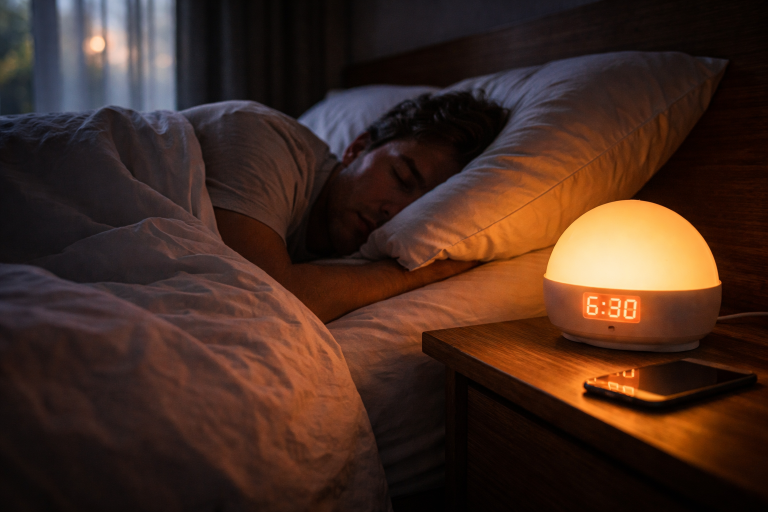
Dawn simulators gradually increase bedroom light intensity over 30 to 90 minutes before your desired wake time, mimicking natural sunrise. The light penetrates closed eyelids during the final stages of sleep, potentially providing circadian benefits while facilitating more natural awakening.
Research on dawn simulation shows promising results for seasonal affective disorder and difficulty waking. A review combining nearly thirty years of data concluded that dawn simulation was effective for treating seasonal mood symptoms and often matched antidepressant medications in efficacy. For those who struggle with morning grogginess, our sunrise alarm clock reviews explore options in this category.
Implementing Light Therapy: Practical Protocols
Translating research findings into daily practice requires attention to several practical considerations. The following protocols address common treatment scenarios, though individual responses vary and adjustments may be necessary.
Protocol for Delayed Sleep Phase
Begin light therapy immediately upon waking, even if this feels earlier than natural. Position your 10,000 lux light box 16 to 24 inches from your face and use it for 30 minutes while eating breakfast or checking emails. Avoid looking directly at the light but keep your eyes open and face toward the device.
Simultaneously, minimize bright light exposure in the evening hours. Consider blue light blocking glasses after 7 or 8 PM, and dim household lighting as bedtime approaches. This combination of morning light exposure and evening light restriction produces the strongest phase-advancing effects.
Expect gradual improvement over one to two weeks rather than immediate results. Stanford Health Care notes that after the desired sleep schedule is attained, patients should maintain a fixed rise time even on weekends and continue morning light exposure, though the duration can often be reduced for maintenance.
Protocol for Seasonal Sleep Disruption
For seasonal affective disorder affecting sleep, use your light box for 20 to 30 minutes each morning as early as possible after waking. Consistency matters more than duration. Daily use throughout autumn and winter months typically provides the best symptom control.
Harvard Medical School experts note that light therapy should be used within 30 minutes of waking for maximum benefit. The treatment works by suppressing melatonin, signaling to your body that it is time to be awake and alert despite the darkness outside.

Protocol for Shift Workers
Night shift work creates a harder problem than a simple phase shift, because you need alertness during hours your body expects darkness and sleep during hours it expects light. Research suggests using bright light during the first half of your shift rather than stretching exposure across the whole night. Sessions of 20 to 40 minutes at the start of your shift, using medium illuminance in the 900 to 6,000 lux range, tend to be more practical and roughly as effective as continuous exposure for hours.
Timing also matters across the run of shifts, not just within one night. The Working Time Society consensus on light interventions for shift workers found that light therapy works best during the first three night shifts of a rotating schedule, before your circadian system has fully adjusted. Pair this with dark sunglasses on the drive home each morning, since sunlight at that hour tells your brain it is time to be awake, exactly when you need to be falling asleep.
Rotating and permanent night schedules call for different strategies on days off. If you work permanent nights and want to protect your adjustment, keep using light therapy and dark glasses discipline even when you are not working. If you are cycling back toward a normal schedule between rotations, drop the light therapy and get morning sunlight instead to help your clock advance back to conventional timing. This distinction gets missed often, and getting it backward can undo weeks of adaptation. Shift work sleep disorder affects an estimated 10 to 40 percent of people working non-traditional schedules, so if light management and sleep hygiene together are not enough, a sleep specialist can offer additional options such as prescription wake-promoting medication.
Combining Light Therapy with Other Interventions
Light therapy rarely works in isolation. For optimal results, pair it with consistent sleep scheduling, appropriate sleep hygiene practices, and in some cases, strategically timed melatonin supplementation. The combination often produces better outcomes than any single intervention alone.
In my experience managing anxiety-driven insomnia, I found that morning walks outdoors, even on cloudy days, provided natural light exposure that complemented my other sleep strategies. I cannot overstate how powerful even 20 minutes of early morning outdoor time became for establishing a consistent sleep-wake rhythm. While I primarily relied on behavioral techniques and occasional melatonin, the addition of morning light anchored my circadian timing in ways that indoor-only routines never accomplished.
Safety Considerations and Side Effects
Light therapy is generally considered safe with minimal side effects, but several precautions apply. Understanding potential risks helps you use this treatment appropriately and recognize when to seek medical guidance.
Common Side Effects
The most frequently reported side effects include eye strain, headache, nausea, and irritability. These symptoms typically occur when starting treatment and often diminish as your body adjusts. Reducing the duration of light exposure or increasing the distance from the device can help manage these effects.
According to the American Academy of Sleep Medicine, light therapy does not appear to produce major side effects and has a good safety record when used within proper limits for intensity and time. Minor side effects like dryness of skin and eye irritation can often be addressed with humidifiers and breaks during treatment sessions.
Precautions and Contraindications
Individuals with certain eye conditions including retinitis pigmentosa, macular degeneration, or diabetic retinopathy should consult an ophthalmologist before beginning light therapy. Similarly, those who have had cataract surgery or lens removal may need additional precautions.
Some medications increase photosensitivity, potentially making light therapy problematic. These include certain antibiotics like tetracycline, mood stabilizers including lithium, and some cardiac medications. If you take photosensitizing drugs, discuss light therapy with your physician before starting treatment.
People with bipolar disorder should use light therapy only under psychiatric supervision. Isolated cases of treatment-emergent mania have been reported, making professional monitoring essential for this population. Harvard Medical School specifically recommends that bipolar patients consult a mental health professional before trying light therapy.
What the Research Shows About Effectiveness
The evidence base for light therapy varies by condition, with strongest support for circadian rhythm disorders and seasonal affective disorder. Understanding what research actually demonstrates helps set appropriate expectations for treatment outcomes.
A comprehensive meta-analysis published in Sleep Medicine Reviews examined 53 studies with over 1,150 participants and found light therapy effective for treating sleep problems generally, with effect sizes of 0.39 for general sleep problems, 0.41 for circadian rhythm disorders, 0.47 for insomnia, and 0.30 for sleep problems related to dementia. These moderate effect sizes suggest meaningful but not dramatic improvements for most individuals.
For seasonal affective disorder specifically, a JAMA Psychiatry systematic review found that bright light therapy was associated with a 41% remission rate in people with nonseasonal depression, significantly higher than control conditions. The American Psychiatric Association now recognizes light therapy as an effective supplementary treatment extending beyond seasonal depression to other depressive disorders.
However, studies examining light therapy for primary insomnia without circadian disruption show more mixed results. A scoping review found that trials in insomnia patients showed no significant effect of light therapy timing or intensity on standard sleep measures. This suggests that light therapy works best when circadian misalignment contributes to the sleep problem rather than for insomnia caused by other factors.
When Light Therapy May Not Be the Answer
Despite its benefits, light therapy is not universally effective and may not address the underlying cause of your sleep difficulties. Recognizing when to consider other approaches saves time and frustration.
If your primary issue is sleep maintenance rather than sleep onset, meaning you fall asleep fine but wake repeatedly during the night, light therapy is less likely to help. Similarly, anxiety-driven insomnia, where racing thoughts prevent sleep regardless of circadian timing, requires different interventions focused on the anxiety component.
From my own journey, I eventually realized that my sleep problems stemmed primarily from anxiety rather than circadian disruption. While morning light exposure became part of my routine, the real breakthroughs came from cognitive techniques like worry diaries and breathing exercises that addressed the anxious thoughts keeping me awake. Getting upset about not sleeping is like getting upset that it is raining outside. It accomplishes nothing and actually makes things worse. Acceptance of occasional difficult nights, combined with evidence-based anxiety management, proved more valuable than any single sleep product or technique.
Sleep apnea, restless legs syndrome, and other medical conditions affecting sleep require their own specific treatments. Light therapy cannot substitute for CPAP therapy, iron supplementation for restless legs, or other condition-specific interventions. If you have not identified the cause of your sleep problems, consulting a sleep specialist should precede any treatment decisions.
Working with Healthcare Providers
While light therapy is available without prescription, working with healthcare providers optimizes treatment success and ensures safety. Several professionals can contribute to effective light therapy implementation.
Sleep medicine specialists can assess circadian timing through sleep diaries, actigraphy, or measurement of dim light melatonin onset. This information helps determine optimal treatment timing based on your individual circadian phase rather than general recommendations. The precision of timing affects outcomes significantly.
For seasonal affective disorder, psychiatrists or psychologists can coordinate light therapy with other treatments including medications and psychotherapy. Research consistently shows that combination approaches outperform single interventions for depression-related sleep disturbances.
If your light therapy does not produce expected results after several weeks of consistent use, professional reassessment can identify whether timing adjustments, intensity changes, or alternative treatments might be more appropriate. Persistence with ineffective treatment wastes time that could be spent on approaches better suited to your specific condition.
Key Takeaways
Light therapy offers a safe, effective, non-pharmaceutical option for sleep disorders involving circadian rhythm disruption. Morning bright light exposure advances the circadian clock for delayed sleep phase, while evening exposure delays it for advanced phase. Seasonal affective disorder responds well to daily morning light therapy throughout darker months.
Success requires appropriate device selection, correct timing relative to your sleep disorder, and consistent daily use over weeks rather than days. Combining light therapy with good sleep hygiene, consistent schedules, and addressing any underlying anxiety or medical conditions produces the best outcomes.
Light therapy is not a universal solution. If circadian misalignment is not the primary driver of your sleep problems, other interventions may prove more effective. Working with healthcare providers helps identify whether light therapy suits your situation and optimizes treatment parameters for your individual needs.
The evidence supporting light therapy for appropriate conditions is robust, and the treatment offers an accessible starting point for many people struggling with circadian-related sleep difficulties. With proper implementation, it can become a valuable component of comprehensive sleep improvement strategies.
Read more articles on the Light Therapy Lamps Hub.
About the Author
Scott Hilliard has spent over a decade managing anxiety-driven insomnia and researching evidence-based sleep solutions. His personal journey through sleep struggles, professional consultations, and extensive product testing informs the practical, skeptical approach found throughout liveworksleep. When not writing about sleep, Scott prioritizes morning walks, consistent bedtimes, and the acceptance-based approach to sleep challenges that transformed his relationship with rest.
Medical Disclaimer
This article provides general information about light therapy for sleep disorders and should not substitute for professional medical advice. Light therapy can interact with certain medications and eye conditions. Consult your healthcare provider before beginning any new treatment, particularly if you have bipolar disorder, eye conditions, or take photosensitizing medications. Persistent sleep problems warrant evaluation by a qualified sleep specialist to identify underlying causes and appropriate treatments.
Frequently Asked Questions
How long does light therapy take to work for sleep disorders?
Most people notice improvements within one to two weeks of consistent daily use, though full benefits may take three to four weeks. Circadian rhythm shifts happen gradually, with typical phase advances of one to two hours per week of treatment. Patience and consistency produce better results than sporadic use.
Can I use a regular bright lamp instead of a light therapy device?
Standard household lighting rarely provides therapeutic light levels. Typical indoor lighting produces only 300 to 500 lux, while effective light therapy requires 2,500 to 10,000 lux. Purpose-built light therapy devices also filter harmful UV wavelengths and are designed for safe extended use at close viewing distances.
Is light therapy safe for long-term use?
Research spanning decades has not identified significant long-term safety concerns with appropriately used light therapy. Many people use light boxes throughout autumn and winter months year after year without problems. Regular eye examinations remain advisable, particularly for those with existing eye conditions or older adults at risk for macular degeneration.
Check current prices on Amazon: Verilux HappyLight → | Circadian Optics Lumos → | JALL Wake Up Light →
Will light therapy help my insomnia if I fall asleep fine but wake during the night?
Light therapy primarily addresses circadian timing rather than sleep maintenance. If your main problem is waking during the night rather than difficulty falling asleep at an appropriate time, other interventions like cognitive behavioral therapy for insomnia may prove more effective. A sleep specialist can help determine whether circadian factors contribute to your nighttime awakenings.
Can I use light therapy with melatonin supplements?
Light therapy and melatonin can work synergistically when timed appropriately. For delayed sleep phase, morning light combined with low-dose melatonin several hours before desired bedtime produces stronger phase advances than either intervention alone. However, the timing of both treatments matters significantly. Working with a healthcare provider helps coordinate these interventions for optimal effect.