Best Sunrise Alarm Clocks 2026: Tested and Ranked
Affiliate Disclosure: As an Amazon Associate I earn from qualifying purchases. Some links on this page are affiliate links. If you buy through them we earn a small commission at no extra cost to you. Our recommendations are based on research into specifications, published evidence and product listings. Learn more.
Waking up to the blaring sound of a traditional alarm feels like being yanked out of sleep by someone who doesn’t care if you’re in the middle of a dream about finally figuring out your life. It’s worth thinking about how you wake up, not only when you go to bed. That’s where sunrise alarm clocks come in.
Shop on Amazon: Philips SmartSleep → | Loftie Clock →
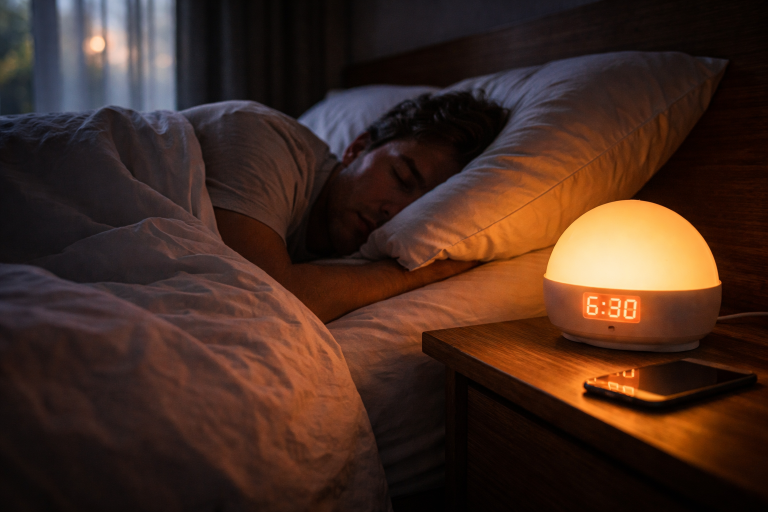
These devices simulate a natural sunrise, gradually filling your bedroom with light over 20 to 60 minutes before your set wake time. The concept is elegantly simple: light entering through your eyelids signals your brain to reduce melatonin production and increase cortisol, helping you transition from sleep to wakefulness the way our ancestors did for millennia before smartphones invaded our bedrooms.
Another sleep gadget promising to solve every problem can invite skepticism, but the science behind sunrise alarm clocks is surprisingly solid. If you’re struggling with dark winter mornings or just want a gentler way to start your day, this guide will help you find the best sunrise alarm clock for your needs in 2025.

Why Sunrise Alarm Clocks Actually Work
Your body runs on an internal 24-hour clock called the circadian rhythm, which regulates when you feel alert and when you feel sleepy. Light is the primary external cue that keeps this rhythm synchronized with the outside world. When morning light hits your eyes, it sends signals to your brain’s hypothalamus, telling your body it’s time to wake up.
Traditional alarm clocks jolt you awake with sudden noise, often in the middle of a deep sleep stage, leaving you groggy and disoriented. This phenomenon, called sleep inertia, is that foggy feeling where you can barely remember your own name for the first ten minutes after waking up. Research published in BMC Psychiatry found that simulated dawn improved subjective sleep quality during dark winter months, with benefits appearing after just six days of use.
Sunrise alarm clocks work by gradually increasing light intensity, mimicking a natural dawn. This gentle transition helps suppress melatonin (the sleep hormone) while boosting cortisol (the wake-up hormone) over 20 to 60 minutes. The result? You wake up feeling more naturally alert rather than being shocked into consciousness.

Key Features to Consider
Light Brightness and Quality
The effectiveness of a sunrise alarm clock depends heavily on its light output. Research suggests that dawn simulation peaking at around 250 lux is effective for most people, though individual preferences vary. Some clocks max out at 100 lux (which might not be bright enough for heavy sleepers), while premium models reach 300+ lux.
Light quality matters too. The best sunrise alarm clocks progress through warm orange and red tones before reaching bright white light, closely mimicking an actual sunrise. Cheaper models often jump straight to harsh white light, which defeats the purpose of a gentle wake-up.
Why Light Colour Matters More Than Brightness
Lux numbers get all the attention in spec sheets, but colour temperature is worth checking as well. A unit can be bright enough on paper yet have a cool, blue-ish cast.
Models such as the Philips SmartSleep and the Lumie Bodyclock start with deep amber tones around 2000K and shift gradually toward daylight white closer to 3500K over the course of the wake window. That progression mirrors an actual sunrise. Short-wavelength blue light is what suppresses melatonin most effectively, which is useful late in the cycle.
If you’re comparing two devices with similar lux ratings, check whether the manufacturer specifies a warm starting temperature. If they only list maximum brightness, that’s often a sign the colour progression was an afterthought, and it’s the main reason cheap sub-$40 sunrise alarms tend to disappoint even when they’re technically bright enough.
Sunrise Duration Options
Most sunrise alarm clocks offer 20 to 40 minute sunrise durations, but some allow customization from as short as 10 minutes to as long as 90 minutes. Preferences can differ. The ability to adjust duration means you can experiment to find your sweet spot.
Sound Options
While the light should be the primary wake-up mechanism, most sunrise alarm clocks include backup sounds. The quality varies dramatically. Premium models offer nature sounds that actually sound like nature (not a computer’s approximation of a bird having an existential crisis). Budget options often provide only harsh beeping.
Relying solely on light can be a worry if you’re a heavy sleeper or have an important early meeting.
Additional Features
Modern sunrise alarm clocks often double as sound machines, bedside lamps, and meditation tools. Some offer sunset simulation to help you wind down at night, which aligns nicely with managing sleep anxiety through evening routines. App connectivity, FM radio, and customizable light colors are other common features. These extras can add value, but they also increase the price, so consider what you’ll actually use.

Best Sunrise Alarm Clocks of 2025
Hatch Restore 3: Best Overall Sunrise Alarm Clock
Price: $170 | Sunrise Duration: Customizable | Max Brightness: 100% customizable | Subscription: Optional Hatch+ ($4.99/mo or $49.99/yr)
The Hatch Restore 3 represents the current pinnacle of sunrise alarm clock technology. Released in early 2025, it improves on its already excellent predecessor with phone-free controls and an expanded sound library that doesn’t require a subscription to access the basics.
What sets the Hatch Restore 3 apart is its comprehensive approach to sleep. This isn’t just a wake-up light; it’s a complete sleep companion. You can create customized wind-down routines with dimming light and calming sounds, then wake to your choice of over 20 sunrise simulations paired with nature sounds, music, or even guided meditations. The “Big Button” on top makes it genuinely usable without fumbling for your phone in the dark, a small detail that makes a significant difference in practice.
The sunrise quality is excellent, with smooth color transitions and sufficient brightness for most bedroom sizes. Where the Hatch Restore 3 really shines (pun intended) is its versatility. Beyond the alarm function, it works as a reading light, sound machine, and meditation device. It also offers wind-down routines for the evening.
Pros:
- Excellent sunrise simulation with natural color progression
- Phone-free controls for minimal screen exposure
- Extensive sound library (60+ options without subscription)
- Wind-down and wake-up routine customization
- Works as reading light and sound machine
- Sleek, minimalist design
Cons:
- Premium price point at $170
- Best features require Hatch+ subscription ($60/year adds up)
- Requires initial app setup (though can run offline after)
- Not as bright as some alternatives for very large rooms
Best For: Anyone serious about improving both their wind-down and wake-up routines who values app-free functionality and design aesthetics. Worth the investment if you’ll use it as a multi-purpose sleep tool.
Philips SmartSleep Wake-Up Light (HF3650): Best Sunrise Simulation
Price: $100 to $200 | Sunrise Duration: Check current spec on Amazon | Max Brightness: Check current spec on Amazon | Subscription: None
The Philips SmartSleep HF3650 is a dedicated wake-up light that focuses on one thing: simulating a natural sunrise and sunset. Where other models try to be everything, Philips keeps the core experience front and centre.
The idea is a gradually intensifying light that fills the room rather than beaming directly into your face like a flashlight, with customizable sunrise, sunset and sound profiles. Philips also describes it as clinically proven to give an easier wake-up.
The HF3650 includes an FM radio, a speaker, smart snooze, a bedside lamp mode, a phone charging dock, an auto-dimming display, power back-up, and a sunset simulation with RelaxBreathe light-guided breathing for winding down.
Expect a dedicated device with its own controls, and allow some nightstand space for it. If your priority is a realistic sunrise simulation, the Philips SmartSleep is a strong choice.
Pros:
- Customizable sunrise and sunset profiles
- FM radio, speaker and phone charging dock
- Clinically proven effectiveness
- No subscription required
- Multiple lights and sounds
- Sunset simulation and RelaxBreathe for bedtime
Cons:
- Takes up nightstand space
- Price is higher than budget wake-up lights
Best For: Sleep purists who want the most realistic sunrise simulation and don’t need smart features or extensive sound libraries. If you value quality over quantity and plan to use this primarily as a wake-up light, this is your best option. For a detailed comparison between top models, check out our analysis of Hatch vs Philips sunrise alarms.

Lumie Bodyclock Luxe 700: Best Light Quality for Sunrise Purists
Price: $100 to $200 | Sunrise Duration: Customizable | Max Brightness: High | Subscription: None
The Lumie Bodyclock Luxe 700 is the most polished sunrise alarm in this guide, and the amber-to-white colour progression is the most natural-looking of any device in this guide. It moves through deep amber, orange, and warm white in a way that genuinely resembles watching a sunrise through thin curtains, not a light bulb on a dimmer switch.
The sound library is larger than the Philips SmartSleep’s, and it includes a sunset feature, which gradually dims the light to help you wind down.
Pros:
- Most natural amber-to-white colour progression tested
- Larger sound library than the Philips SmartSleep
- Sunset wind-down feature included
- No app or subscription required
Cons:
- Premium price point
- No smart wake timing or sleep tracking
- Large footprint, similar to the Philips
Best For: Anyone who wants the most realistic sunrise colour progression available and is willing to pay a premium for it, particularly if mornings are consistently difficult in your household.
Loftie Clock: Best for Breaking Phone Dependence
Price: $100 to $200 (Clock only), $300 to $500 (Clock + Lamp bundle) | Sunrise Duration: 3-9 minutes (requires Loftie Lamp) | Max Brightness: Moderate | Subscription: Optional Loftie+ ($5.99/mo)
The Loftie Clock takes a different approach entirely. While it can be purchased with the Loftie Lamp for sunrise functionality, the clock itself focuses on helping you eliminate your phone from the bedroom. It’s a philosophy as much as a product.
The standout feature is the two-phase alarm system. Nine minutes before your set time, a gentle “wake-up” tone plays briefly, designed to ease you out of deeper sleep stages. Then, at your actual alarm time, the “get-up” tone sounds. It’s surprisingly effective at making waking up feel less brutal. The clock includes over 100 sleep sounds, guided breathwork, bedtime stories, and meditation tracks, all accessible without grabbing your phone.
When paired with the Loftie Lamp, you get sunrise functionality, though it’s more limited than dedicated sunrise alarm clocks. The sunrise only lasts 9 minutes maximum and isn’t as bright as competitors. However, the lamp offers 18 colors and 15 gradients for ambient lighting, making it an excellent mood light throughout the day.
Loftie’s commitment to helping you disconnect from screens before bed is a plus. The clock can run entirely offline after initial setup, and the blackout mode eliminates all light pollution. If your main goal is reducing phone dependence and you want comprehensive wind-down features, Loftie delivers. But if sunrise simulation is your primary concern, you’ll want one of the other options.
Pros:
- Unique two-phase alarm system
- 100+ sleep sounds and wellness content
- Complete offline functionality
- Bluetooth speaker built-in
- Blackout mode for complete darkness
- Helps eliminate phone from bedroom
- Retro-modern aesthetic
Cons:
- Sunrise function requires separate Loftie Lamp purchase
- Limited sunrise duration (max 9 minutes)
- Lower brightness than dedicated sunrise alarms
- Setup requires app and WiFi
- Premium features require subscription
- High total cost for full functionality ($300 to $500 for clock + lamp)
Best For: People committed to breaking phone addiction who value wellness content and are willing to invest in the ecosystem. The clock alone works great for phone-free bedrooms, but serious sunrise needs require the lamp addition. To see how this compares to our top pick, read our detailed Loftie Clock review.
Best Budget Option: JALL Wake-Up Light
Price: under $50 | Sunrise Duration: 10-60 minutes | Max Brightness: Moderate | Subscription: None
If you’re curious about sunrise alarm clocks but hesitant to spend heavily, the JALL Wake-Up Light offers a surprisingly capable entry point. At a fraction of the cost of premium models, it includes most essential features: customizable sunrise duration, seven color options, seven nature sounds, FM radio, and dual alarms.
The sunrise simulation is adequate, though the color progression is less smooth than expensive alternatives and the maximum brightness won’t work for very large rooms. The sounds are digital approximations rather than high-quality recordings, but they’re functional. Setup is straightforward using physical buttons, and the snooze function works via a simple tap.
This clock excels as a test-drive for the sunrise alarm concept. If you discover that gradual light waking works for you, you can upgrade later. If not, you’ve only invested under $50 rather than $100 to $200. The build quality feels budget-appropriate, but mine has lasted over a year without issues. For more affordable alternatives, explore our roundup of the best budget sunrise alarm clocks.
Pros:
- Excellent value at under $50
- Customizable sunrise duration
- Seven color options
- FM radio and nature sounds included
- Dual alarm capability
- Simple setup without app requirement
Cons:
- Lower brightness than premium models
- Digitized nature sounds lack quality
- Less smooth color transitions
- Basic plastic construction
- Limited customization options
Best For: Budget-conscious buyers or anyone wanting to test sunrise alarm clocks before committing to a premium model. Sets realistic expectations while delivering core functionality.

How to Choose the Right Sunrise Alarm Clock
Consider Your Sleep Environment
Room size matters significantly. A clock that works beautifully in a small bedroom might not provide adequate light in a master suite. If you use blackout curtains or have a particularly dark room, you’ll need a brighter model. The Hatch Restore 3’s customizable brightness would suit darker spaces better than budget alternatives.
Your sleep position also matters. If you sleep facing away from your nightstand, ensure the light disperses widely enough to reach you. A wake-up light that fills the room, rather than projecting light directionally, helps here.
Match Features to Your Needs
Be honest about which features you’ll actually use. If you’re primarily interested in waking up more gently, don’t pay extra for meditation content you’ll never access. Conversely, if you struggle with both falling asleep and waking up, comprehensive solutions like the Hatch Restore 3 provide better value than separate devices.
Consider your relationship with technology. If you’re trying to reduce screen time, app-dependent models might undermine that goal despite other benefits. The Philips SmartSleep and Loftie Clock (after initial setup) offer genuinely phone-free operation.
Test It on Someone Who Won’t Be Patient With It
If you’re buying for a household with a reluctant riser, a low-tolerance tester like this is a better judge of real-world usability than a week of your own careful, motivated testing.
Factor in Long-Term Costs
Subscription models can significantly impact total cost. The Hatch Restore 3’s optional $60/year Hatch+ subscription adds up over time, potentially exceeding the initial purchase price within a few years. If you’re budget-conscious, the Philips SmartSleep offers all features upfront with no ongoing costs. This mirrors my skepticism about sleep tracking subscriptions, where you end up paying indefinitely for features that should be included.
Start with Your Budget
Sunrise alarm clocks range from $30 to $360 depending on features and quality. Budget options ($30-60) provide basic functionality to test the concept. Mid-range models ($100-180) offer better light quality, sound options, and build quality. Premium options ($180+) include comprehensive features, superior engineering, and often ecosystem integration.
Starting mid-range is a sensible approach unless you’re certain about your needs. The Hatch Restore 3 and Philips SmartSleep represent the quality tier where you’re not making significant compromises, but you’re also not paying for features you might never use.
Frequently Asked Questions
Do sunrise alarm clocks actually work?
Yes, for most people. Research published in peer-reviewed journals shows that simulated dawn can improve sleep quality and make waking easier. However, effectiveness varies by individual. Light sleepers often wake to light alone, while heavy sleepers might need the backup audio alarm. The key is consistent use; benefits typically appear after about a week of regular use.
Sunrise alarm clocks don’t solve underlying sleep issues.
What’s the ideal sunrise duration?
Most research suggests 30 minutes as optimal, but individual preferences range from 10 minutes (if you prefer quicker wake-ups) to 90 minutes (for very gradual transitions). Start with 30 minutes and adjust based on results.
Can I use a sunrise alarm clock with blackout curtains?
Absolutely. In fact, sunrise alarm clocks work best in dark rooms where they’re the primary light source. Just ensure you choose a model with sufficient brightness for your room size.
How bright should a sunrise alarm clock be?
Research suggests around 250 lux is effective for most people, though preferences vary. Rooms under 150 square feet can work with 100-200 lux models. Larger bedrooms or rooms with high ceilings benefit from 250-300 lux options; check the current brightness spec on any model before you buy. Most quality sunrise alarm clocks offer adjustable brightness, so you can find your ideal level.
Is light colour or brightness more important in a sunrise alarm clock?
Colour. A warm amber starting point that shifts gradually toward white differs from a cool white light that simply gets brighter, even at the same lux rating. If you’re comparing two devices, check whether the manufacturer specifies a warm starting temperature rather than just a maximum lux figure.
Will a sunrise alarm clock help with seasonal affective disorder (SAD)?
Sunrise alarm clocks may help with mild SAD symptoms by regulating circadian rhythm and providing consistent morning light exposure during dark winter months. However, they’re not a replacement for clinical light therapy (10,000 lux) recommended for treating SAD. Think of sunrise alarms as preventive maintenance rather than treatment for diagnosed seasonal depression.
Can I turn off the sound and use light only?
Most sunrise alarm clocks allow light-only operation, which is actually the recommended use if you’re a light sleeper. The entire point is waking naturally to light rather than sound.
How long does it take to adjust to waking with light?
Most people notice improvement within three to seven days of consistent use. Your brain needs time to associate the gradual light with wake time. Stick with it for at least two weeks before deciding whether it works for you. Also, maintaining consistent wake times (even on weekends) dramatically improves effectiveness.
Final Thoughts
For most people, the Hatch Restore 3 is the best overall choice. It offers excellent sunrise simulation, comprehensive features, and the flexibility to serve multiple functions beyond just waking you up. The premium price is justified if you’ll use it as a complete sleep companion rather than just an alarm clock.
If your sole focus is the most realistic sunrise simulation and you don’t need app integration or extensive sound libraries, the Philips SmartSleep Wake-Up Light (HF3650) is a strong pick. Philips describes it as clinically proven to give an easier wake-up, which suits sunrise purists.
Budget-conscious buyers or anyone wanting to test the concept before committing should start with the JALL Wake-Up Light. At under $50, it removes the financial barrier while providing adequate functionality to determine if sunrise waking works for you.
Whatever you choose, remember that a sunrise alarm clock is a tool, not a magic solution. It works best when combined with other sleep hygiene practices: consistent sleep schedules, a cool dark bedroom, limiting screen time before bed, and managing anxiety through proven techniques. But if you’re tired of feeling like mornings are a personal attack, giving your body light to wake up to might just transform your relationship with your alarm clock.
Sunrise alarm clocks replace an abrupt alarm with a gradual transition from sleep to wakefulness, which many people find gentler.
Read more articles on the Sunrise Alarm Clocks Hub.
About This Guide
LiveWorkSleep publishes guides to sleep products and sleep science. Recommendations are based on research into specifications, published evidence and product listings. This page is general information, not medical advice.
Medical Disclaimer: The information provided in this article is for educational purposes only and is not intended as a substitute for professional medical advice, diagnosis, or treatment. Sunrise alarm clocks are wellness tools, not medical devices. If you have diagnosed sleep disorders, seasonal affective disorder, or other medical conditions affecting sleep, consult with a healthcare provider before making changes to your sleep routine. Individual results may vary. Affiliate links in this article may generate commission at no additional cost to you.
Shop on Amazon: Philips SmartSleep → | Loftie Clock → | JALL Wake Up Light →