Apple Watch vs Garmin for Sleep: Which Tracks Sleep Better?
Affiliate Disclosure: As an Amazon Associate I earn from qualifying purchases. Some links on this page are affiliate links. If you buy through them we earn a small commission at no extra cost to you. Our recommendations are based on research into specifications, published evidence and product listings. Learn more.
Apple Watch or Garmin? Here's the Honest Pick for Sleep
Apple Watch SE 3 vs Garmin Venu 3 vs Budget Band: Side-by-Side
Best Sleep Data  Garmin Venu 3 Check Price on Amazon |  Apple Watch SE 3 Check Price on Amazon |  Fitbit Inspire 3 Check Price on Amazon | |
|---|---|---|---|
| Battery Life | ~14 days | ~18 hours | Check current spec on Amazon |
| Sleep Stages | Yes + Sleep Score | Yes (basic) + iPhone Health | Yes + Sleep Score |
| Works With iPhone | Yes | Required | Yes |
| Works With Android | Yes | No | Yes |
| Subscription | None | None (or AutoSleep $7.99) | 3-month Google Health Premium included |
| Best For | Battery-conscious data nerds | iPhone users wanting one device | Anyone wanting basic sleep tracking from a simple band |
Choosing between Apple Watch and Garmin for sleep tracking means weighing two very different philosophies: the sleek, integrated world of Apple Watch and the fitness-first approach of Garmin. Choosing between these platforms depends more on your lifestyle than on pure accuracy numbers.
Both Apple Watch and Garmin watches track sleep, but they approach the challenge from fundamentally different angles. Apple Watch Series 8 and newer models emphasize ecosystem integration and comprehensive health tracking, while Garmin devices like the Forerunner and Fenix series prioritize endurance sports metrics with sleep as a supporting feature.
A 2024 study comparing Apple Watch Series 8 against polysomnography found the device achieved 95% sensitivity for detecting sleep versus wake, with substantial agreement in identifying sleep stages. However, the research also revealed limitations: Apple Watch significantly underestimated deep sleep by an average of 43 minutes while overestimating light sleep by 45 minutes.
Shop on Amazon: Apple Watch SE 3 → | Garmin Venu 3 →
Garmin devices face steeper accuracy challenges. Research validates that Garmin watches correctly identify 98% of sleep epochs but struggle with wake detection at only 27% sensitivity. More concerning, a 2022 validation study found Garmin’s multi-state sleep categorization agreement with polysomnography was just 50%, with notably poor REM sleep detection and a tendency to misclassify 61% of deep sleep as light sleep.

Sleep Tracking Accuracy: What the Research Shows
Independent validation studies reveal a clear accuracy gap between these platforms.
Apple Watch Series 8 performed better than Garmin Forerunner 245 in head-to-head polysomnography testing. Apple achieved 88% overall agreement for sleep-wake detection with Cohen’s kappa of 0.30, while Garmin reached 89% agreement but with similar fair-level statistical agreement. The devices diverged significantly in stage-specific accuracy.
For multi-state sleep classification, Apple Watch correctly identified 53% of all sleep stages compared to polysomnography. Garmin managed only 50% agreement. Both devices struggled most with deep sleep detection, but Apple Watch demonstrated better sensitivity for light sleep at 44% compared to Garmin’s higher 68% sensitivity, though this came at the cost of misclassifying much of deep sleep.
The practical implication: neither device provides clinical-grade sleep stage data. When comparing your results to the best sleep trackers overall, you’ll find both Apple and Garmin trail behind ring-based trackers like Oura for pure sleep accuracy.
Research from Brigham and Women’s Hospital found Apple Watch Series 8 had an absolute bias of 48.1 minutes for total sleep time, with proportional bias increasing for people with poorer quality sleep. Garmin showed similar patterns with 45.3 minutes absolute bias, though it consistently overestimated total sleep time by approximately 44 minutes compared to polysomnography.
Battery Life: The Daily Trade-Off
Battery life remains Apple Watch’s Achilles heel for sleep tracking. The Apple Watch SE 3 is rated for 18 hours of battery life in its listing, so plan on charging it daily. This creates an inconvenient reality: you need to charge your watch either before bed or immediately upon waking, which interrupts the seamless tracking experience.
The pre-bed charging routine Apple Watch requires can be disruptive for some users. The manufacturer suggests that thirty minutes on the charger during an evening routine can provide enough power for overnight tracking plus the next day. However, this approach means missing activity data during that charging window, and any disruption to your routine can leave you with a dead watch at bedtime.
Garmin devices flip this equation entirely. Forerunner models typically last 7-14 days between charges, while higher-end Fenix watches can stretch to 3-4 weeks in smartwatch mode. This means genuinely wearing your tracker 24/7 without planning charging windows around sleep tracking.
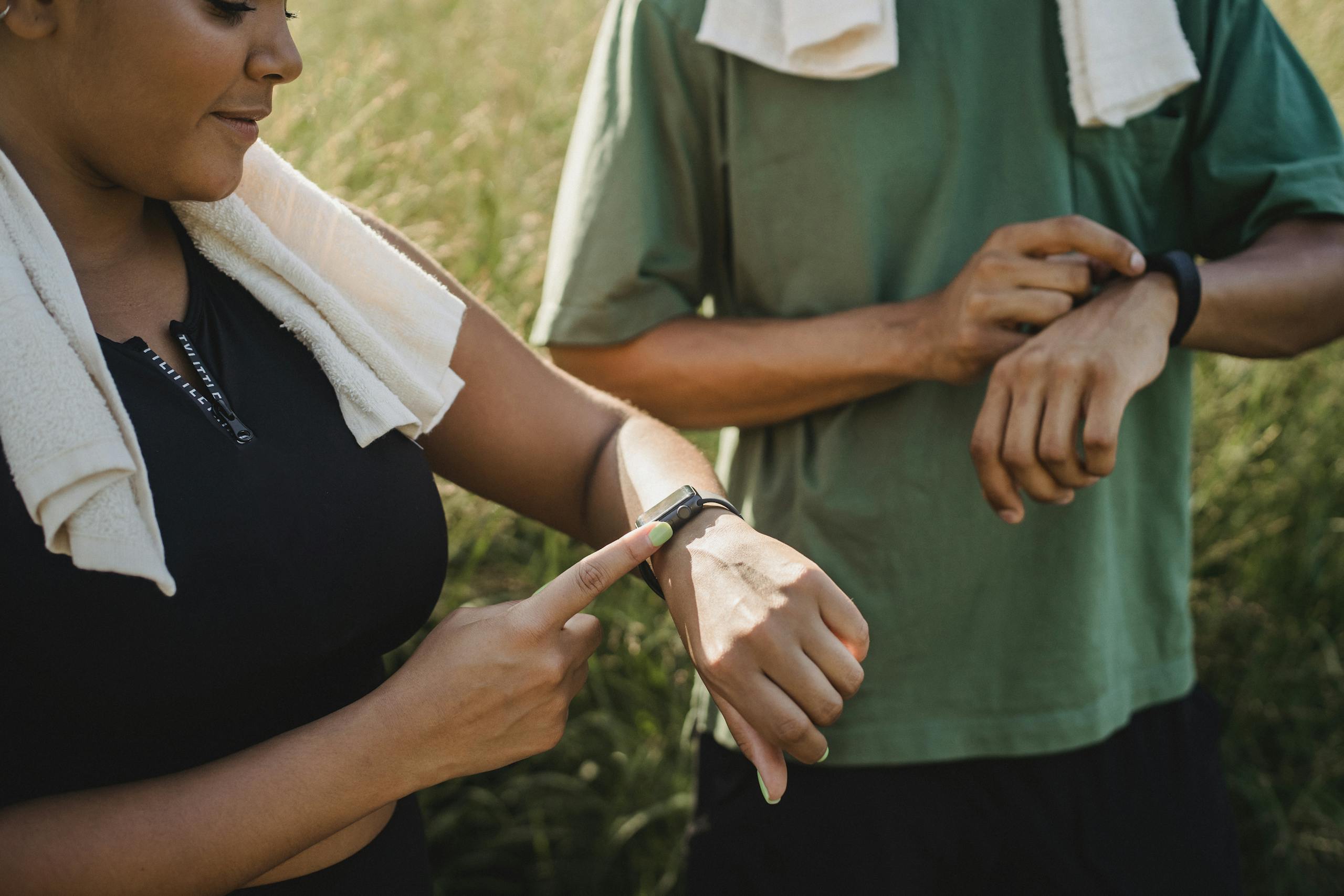
The battery advantage extends beyond convenience. Longer battery life means more consistent data collection for pattern recognition. When evaluating Garmin versus Fitbit for sleep tracking, both platforms offer multi-day battery life that makes continuous monitoring practical.
Health Metrics and Sleep Features
Apple Watch delivers comprehensive health tracking that extends well beyond sleep. The platform monitors heart rate variability, blood oxygen levels, respiratory rate during sleep, and wrist temperature variations that may indicate illness or menstrual cycle changes. watchOS 10 introduced detailed sleep staging with time spent in REM, Core (light), and Deep sleep.
Sleep Focus mode automatically activates Do Not Disturb and dims the display during your scheduled sleep window. The platform tracks sleep consistency, showing how regular your sleep schedule has been week over week. However, Apple doesn’t provide a daily sleep score, instead focusing on duration and consistency metrics.
Garmin’s approach emphasizes recovery metrics through its Body Battery feature, which uses heart rate variability, stress, and activity to calculate your energy reserves throughout the day. Sleep quality directly influences your morning Body Battery score, creating a clear connection between rest and readiness.
Advanced Garmin watches (Forerunner 255 and up, Fenix series, Epix) provide sleep staging, HRV status, and Training Readiness scores that incorporate sleep quality. The platform tracks sleep consistency and provides a sleep score that factors in duration, quality, and restfulness. For athletes, these recovery metrics prove more actionable than Apple’s simpler duration-focused approach.
Both platforms struggle with daytime nap detection. Neither automatically tracks afternoon sleep sessions reliably, though both allow manual nap logging. This limitation matters if you’re comparing devices to Oura Ring versus Apple Watch, where Oura’s continuous tracking captures daytime rest more consistently.
Ecosystem Integration and Platform Lock-In
Apple Watch requires an iPhone, creating platform dependency that influences your entire tech ecosystem. If you use iPhone, iPad, and Mac, the integration delivers seamless data sharing through Apple Health. Your sleep data automatically populates across devices, integrates with third-party health apps, and synchronizes with your Health Records from participating medical providers.
The ecosystem advantage extends to features like Sleep Focus, which activates Wind Down across all your Apple devices. Your iPhone, iPad, and Apple Watch all enter quiet mode together, reducing notifications and dimming screens to support your sleep routine. For users already invested in Apple’s ecosystem, this tight integration justifies the platform despite battery limitations.

Garmin Connect works with both iOS and Android, providing platform flexibility that Apple cannot match. The app synchronizes sleep data across devices and integrates with third-party platforms like Strava, TrainingPeaks, and MyFitnessPal. However, Garmin’s health ecosystem lacks Apple’s depth for medical integration and comprehensive health records.
Data portability differs significantly. Apple Health allows extensive export options for sharing with healthcare providers or migrating to other platforms. Garmin provides good export functionality but focuses primarily on fitness-oriented formats. When examining WHOOP versus Garmin for sleep tracking, both offer more flexible cross-platform options than Apple’s iOS requirement.
Scott’s Experience: When Sleep Trackers Create Anxiety
A device might report figures such as 22% deep sleep and 43% light sleep, with a recovery score of 34% for the day. What did that actually mean? Should I cancel my training session? Was I damaging my health by pushing through?
The numbers created their own anxiety loop. You could feel fine in the morning, energized and ready to tackle the day, then the app would inform you that your sleep was suboptimal and your readiness score was low. Suddenly you’d start questioning whether you actually felt good or if you were just ignoring signals your body was supposedly sending.
For some users, constant tracker monitoring does not lead to better sleep. It was creating a new source of stress. Did I get enough deep sleep? Why was my REM percentage lower than yesterday? The questions can multiply while actual sleep quality remains unchanged.
Sleep tracking data is most useful as trend information rather than a daily prescription. Consistently poor scores over two weeks may be worth investigating. But a single night showing 18% deep sleep instead of 25%? That’s not actionable information. It’s just noise that can trigger unnecessary worry about something I have limited control over anyway.
Apple Watch or Garmin? Here's the Honest Pick for Sleep
Price and Value Comparison
The Apple Watch SE 3 (GPS, 40mm) is listed at about $219, and the higher-end and cellular Apple Watch models cost more. The platform requires existing Apple ecosystem investment, particularly an iPhone.
Garmin’s sleep tracking lineup spans wider price ranges. The Forerunner 165 (about $199) is the entry point in Garmin’s current running line, with up to 11 days of battery life in smartwatch mode according to its listing. Mid-range options like the Forerunner 570 (about $550) add a training readiness score that draws on sleep quality, recovery and HRV status, according to its listing. High-end Fenix 8 models (about $745 and up) provide comprehensive training load analysis but offer diminishing returns for pure sleep tracking.

Value assessment depends heavily on existing gear. If you already own an iPhone and want an all-purpose smartwatch, Apple Watch delivers strong value despite daily charging. If you prioritize multi-day battery life or use Android, Garmin makes more sense. For pure sleep tracking accuracy, neither justifies their cost compared to dedicated devices like Oura Ring, though they offer broader functionality beyond sleep monitoring.
When considering Fitbit versus Apple Watch for sleep, Fitbit’s lower entry prices ($100-180) provide budget-conscious alternatives. However, both Apple Watch and Garmin offer superior build quality and longer device longevity that may justify higher upfront costs for users planning multi-year use.
Apple Watch or Garmin? Here's the Honest Pick for Sleep
The Verdict: Choose Based on Your Ecosystem and Priorities
Neither Apple Watch nor Garmin delivers clinical-grade sleep tracking. Both underestimate deep sleep, struggle with wake detection, and trail dedicated sleep trackers in raw accuracy. However, they excel as versatile smartwatches that happen to include reasonably good sleep monitoring alongside comprehensive health and fitness features.
Choose Apple Watch if you’re invested in iOS, value seamless ecosystem integration, and accept daily charging as part of your routine. The platform makes sense for users who want an all-purpose smartwatch with good-enough sleep tracking rather than specialized sleep analysis. Apple Health’s medical integration and comprehensive data sharing provide advantages for users managing health conditions or working with healthcare providers.
Choose Garmin if you prioritize multi-day battery life, use Android, or focus on athletic training and recovery metrics. The platform delivers superior value for serious runners and endurance athletes who benefit from Body Battery and Training Readiness scores. Garmin’s cross-platform compatibility and longer battery life make continuous monitoring more practical without daily charging interruptions.
Across the range of available sleep trackers, the best device is generally the one a user will actually wear consistently. Battery anxiety and ecosystem friction matter more than small accuracy differences. If you’re comparing Oura, WHOOP, and Apple Watch, consider whether you want specialized sleep tracking or an all-purpose device that includes sleep monitoring.

The accuracy gap between these platforms matters less than finding a device that fits your life. Sleep tracking works best when it informs decisions without creating anxiety. Whether you choose Apple Watch’s integrated ecosystem or Garmin’s battery endurance, focus on consistent use and long-term trends rather than obsessing over nightly fluctuations in sleep stage percentages.
What if neither Apple Watch nor Garmin is right for you?
Honest reality check after testing both for months: neither is the right answer for everyone. If you already own an iPhone and don’t want a new device, AutoSleep on Apple Watch ($7.99 one-time) gives you most of what Garmin offers without buying anything new — assuming you already have an Apple Watch. If $300+ feels excessive just to track sleep, the Fitbit Inspire 3 gives you automatic sleep tracking and a daily Sleep Score, a simple option for anyone curious but not committed. And if you’re tracking sleep because you suspect a real problem (apnea, persistent insomnia), no consumer wearable on this page is diagnostic — talk to a sleep doctor first, then layer the wearable on top.
Read more articles on the Comparisons Hub.
About the Author
Scott Hilliard is the founder of LiveWorkSleep, which covers sleep products and sleep science. His recommendations are based on research into specifications, published evidence and product listings.
Transparency & Affiliate Disclosure
This article may contain affiliate links, which means liveworksleep may earn a commission if you purchase through these links at no additional cost to you. These commissions support the site’s operation and allow continued production of evidence-based sleep content. All product recommendations are based on research and genuine assessment, not commission rates. Only products believed to provide real value are recommended.
Medical Disclaimer
The information provided in this article is for educational purposes only and should not replace professional medical advice. Sleep tracking devices are not medical devices and should not be used for diagnosing or treating sleep disorders. If you experience persistent sleep problems, consult a qualified healthcare provider or sleep specialist for proper evaluation and treatment.
Frequently Asked Questions
Is Apple Watch or Garmin more accurate for sleep tracking?
Apple Watch Series 8 demonstrates slightly better sleep tracking accuracy than Garmin in independent validation studies. Research shows Apple Watch achieved 88% agreement for sleep-wake detection and 53% for multi-state sleep classification, compared to Garmin’s 89% and 50% respectively. However, both devices significantly underestimate deep sleep and struggle with wake detection, trailing ring-based trackers like Oura by 5-10% in overall accuracy.
Can Garmin watches track sleep without daily charging?
Yes, Garmin watches offer 7-14 days of battery life for most Forerunner models and up to 3-4 weeks for Fenix series watches. This eliminates the need to plan charging windows around sleep tracking, allowing genuinely continuous 24/7 monitoring without interruption. In contrast, Apple Watch requires daily charging, typically needing 30-60 minutes on the charger either before bed or immediately upon waking.
Does Apple Watch track naps automatically?
No, Apple Watch does not reliably detect daytime naps automatically. Both Apple Watch and Garmin watches primarily track sleep during scheduled sleep windows and struggle to identify unscheduled daytime rest. Users can manually log naps in the Health app, but automatic nap detection remains unreliable on wrist-worn devices compared to ring-based trackers that monitor continuously.
Which device is better for athletes tracking recovery?
Garmin provides more sophisticated recovery metrics for athletes through features like Body Battery, Training Readiness, and HRV Status that directly incorporate sleep quality into training load analysis. Apple Watch offers comprehensive health tracking but lacks the sports-specific recovery analytics that help athletes determine when they’re ready for hard training versus when they need rest.
Check current prices on Amazon: Apple Watch SE 3 → | Garmin Venu 3 →
Can I use Garmin with an iPhone?
Yes, Garmin Connect works seamlessly with iOS devices. While Apple Watch requires an iPhone, Garmin watches work with both iOS and Android, providing platform flexibility. The Garmin Connect app synchronizes sleep data, integrates with third-party fitness platforms, and provides full feature access on iPhone, though without the deep ecosystem integration Apple Watch achieves through Apple Health.
Should I choose a smartwatch or dedicated sleep tracker?
If sleep tracking is your primary concern, dedicated devices like Oura Ring or WHOOP Strap deliver 5-10% better accuracy in sleep stage classification compared to Apple Watch or Garmin. However, smartwatches provide versatile functionality beyond sleep monitoring, including fitness tracking, communication features, and app ecosystems. Choose based on whether you want an all-in-one device or specialized sleep analysis.